lexepub
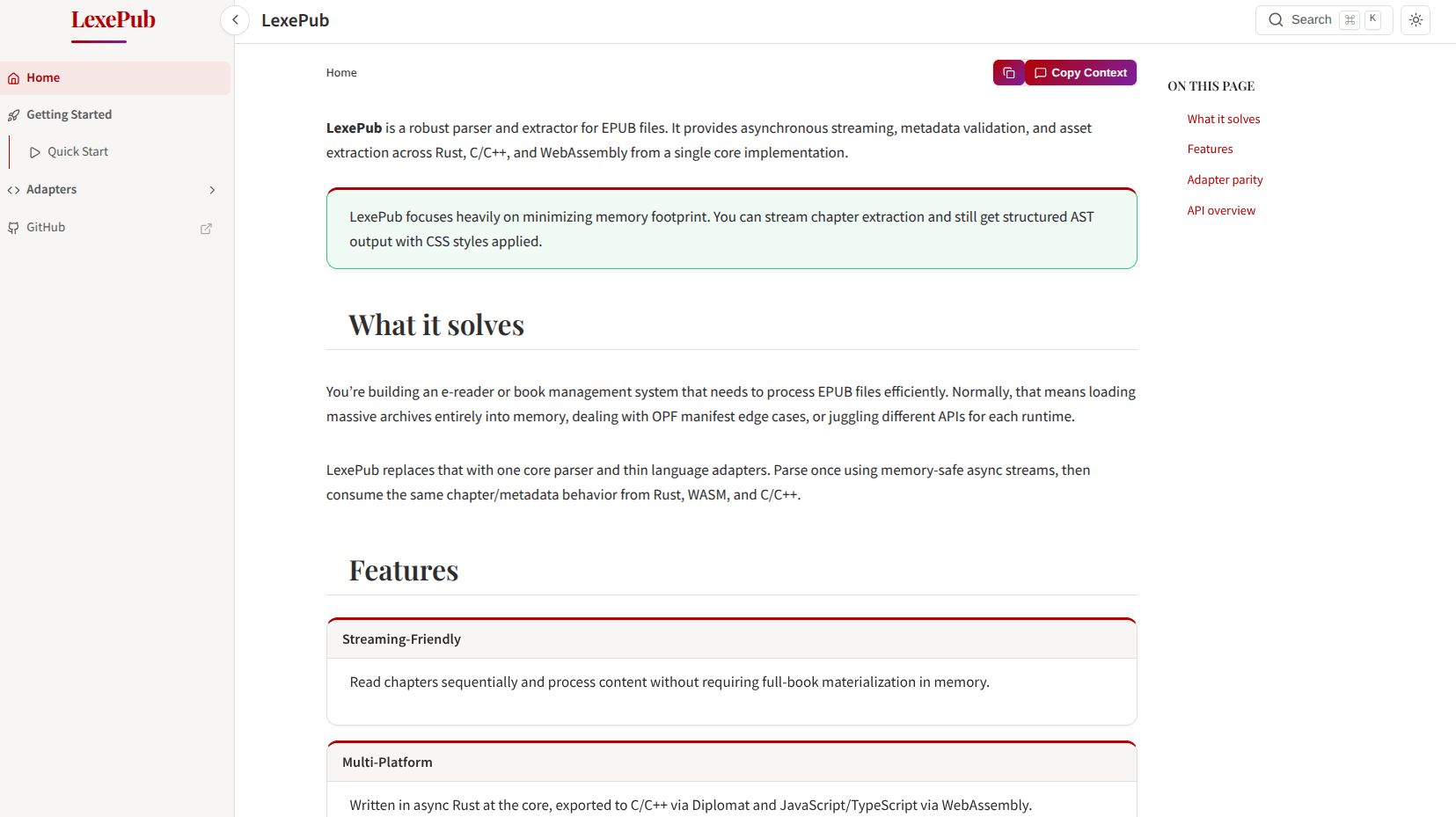
I needed to parse ePub files on embedded hardware with 512KB of RAM. Every existing parser loads the entire ZIP archive into memory first, which is fine on a laptop but absolutely not fine on an ESP32 reading from an SD card. So I built lexepub, a streaming ePub parser in Rust that never loads the whole file.
Why Streaming Matters
An ePub is really a ZIP archive with specific XML files inside. Traditional parsers unzip everything, hold it in RAM, and then parse the XML. For a 10MB ePub on constrained hardware, that’s a non-starter. lexepub reads ZIP entries sequentially using async_zip, parses the container XML and OPF manifest on the fly, and hands you content as it’s found. Memory usage stays constant regardless of file size.
The from_reader API is designed for embedded. Plug in a reader backed by SD card, LittleFS, or flash storage, and you get a fully parsed document without ever holding the whole file.
More Than You’d Expect
The container parser reads META-INF/container.xml. The OPF parser extracts metadata, manifest, and spine. A caching layer stores metadata, AST chapters, text chapters, and word counts so you’re not re-parsing on every access. Chapter Stream implements futures::Stream for async iteration.
But here’s where it gets wild. The CSS parser is 344 lines written from scratch. It handles @media, @supports, @font-face, @page, @import, @namespace, and standard rules. For an ePub library, that’s remarkably complete. You can get text-only content cheaply or full AST with CSS styles applied.
Three Targets
It publishes as a Rust crate on crates.io, an npm package via WASM (wasm-pack plus wasm-bindgen), and builds as C/C++ FFI through Diplomat. Same streaming parser, three different ways to use it.
Check the docs at nellowtcs.me/lexepub. The streaming approach means you can parse an ePub of any size with a fixed memory budget, and honestly that’s the whole point.